
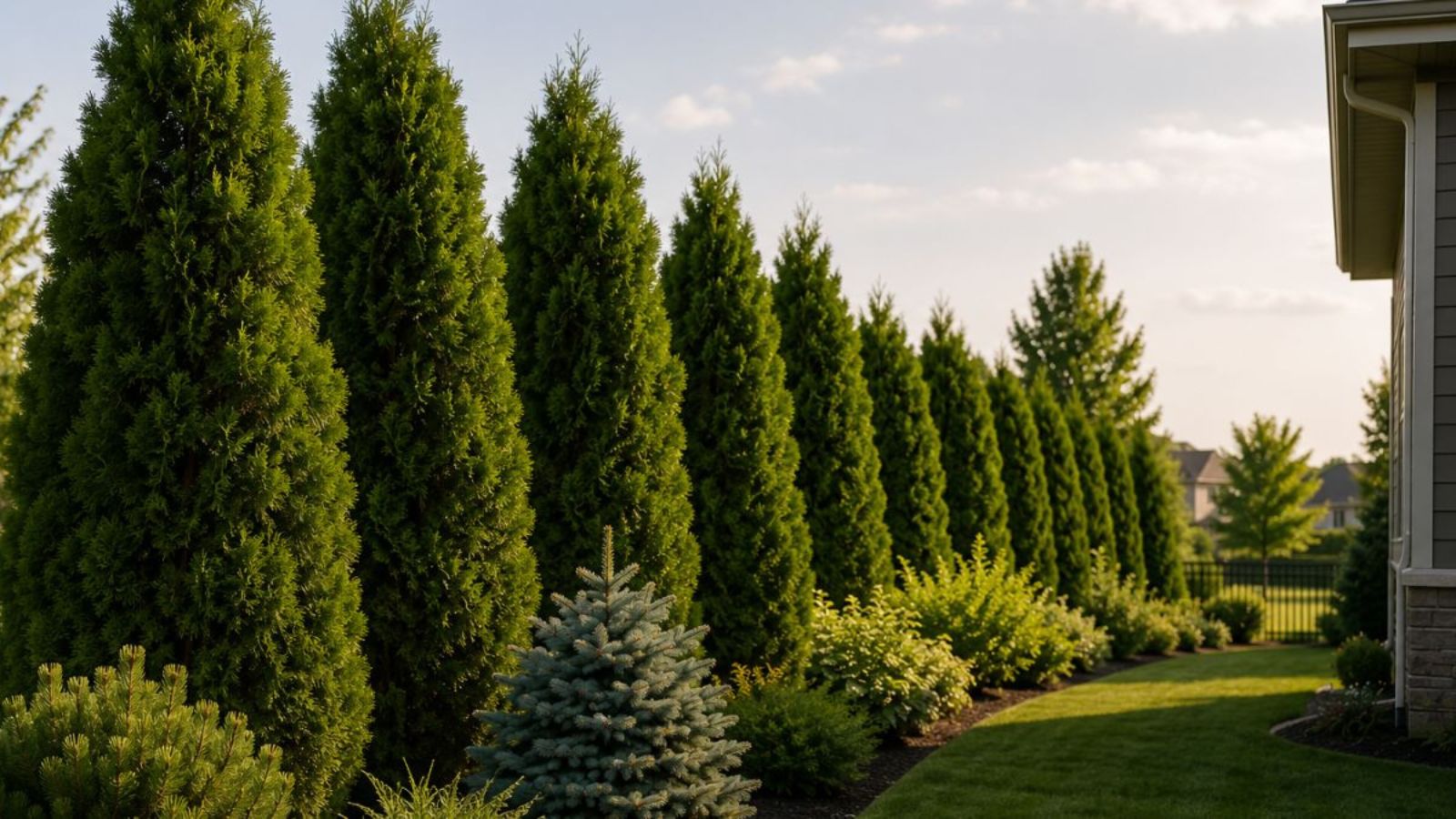
In Omaha, evergreen screening projects rarely begin with plant selection. They begin with a complaint: wind cutting across a yard, patios that only feel usable in certain months, or a property that feels more exposed than expected after moving in.
When we step onto these sites, the conversation rarely starts with plant selection. It tends to circle around why the yard behaves the way it does in the first place.
That shift matters because in Omaha, choosing the best windbreak and privacy evergreens depends on how wind and space interact, not just how plants look in a row.
Wind Sets The Design
On most Omaha properties, wind is not a background condition but the organizing force. It finds the weakest path through a site, often alongside yards, fence lines, or gaps between structures that looked insignificant on paper.
A common early misstep is treating windbreaks as straight visual barriers. In practice, wind does not behave like a line. It moves in pressure streams, accelerating where space tightens and spilling where structure is inconsistent.
Before any planting decisions, we look for physical evidence of those patterns: snow drifting along one edge of a yard, uneven soil drying, or debris consistently collecting in the same corners. Those are more reliable than any site drawing.
Cedar as a Rough Structure
Eastern Red Cedar is often used in Omaha, where conditions are too inconsistent for more refined plantings. We see it perform best on larger or changing properties. These are places where soil, exposure, or maintenance levels vary.
Its value is not in uniformity. Cedar does not create a clean wall, and when planted with that expectation, it often disappoints.
Where it works is in breaking up wind energy over distance. Its irregular branching and tolerance for stress make it more effective as a diffuser than a barrier. On exposed edges, that difference becomes noticeable after only a few seasons of wind cycles.
Spruce On Stable Ground
Colorado Spruce is typically selected for one reason: immediate fullness. In Omaha, that early density is appealing in open yards where privacy feels urgent.
Its long-term performance, however, is tightly linked to site stability. In heavier soils or low areas where moisture collects, we consistently see stress develop over time. The tree may hold its shape externally, while the interior decline begins quietly.
Spacing also determines longevity. When spruce is planted too tightly, airflow becomes restricted as it matures. The outer form remains intact, but the internal structure weakens under repeated seasonal pressure.
Spruce succeeds most reliably on well-drained ground where spacing is planned for maturity, not first-year appearance.
Arborvitae At The Edge
Arborvitae is frequently requested for privacy in residential Omaha neighborhoods because it offers a clean, uniform look early on. That uniformity, however, is highly dependent on exposure conditions.
In sheltered yards, arborvitae performs predictably. In fully exposed sites, especially those facing prevailing winter winds, it reacts quickly. Stress typically appears during establishment years, not after full maturity.
What changes outcomes most is placement strategy. When arborvitae is positioned directly on the wind-facing edge too early, it absorbs conditions it has not yet adapted to. However, when it is introduced slightly behind a buffering layer, performance stabilizes significantly.
Pines As Structure Layer
Pines behave differently from most evergreens used in residential screening. In Omaha field conditions, Austrian and ponderosa pine are rarely chosen for immediate privacy. Instead, they function as long-term structural anchors in larger windbreak systems.
Their role becomes clearer over time. While other species establish visual density, pines gradually shape the way wind flows through a property at a broader scale.
We typically rely on them in outer or intermediate positions, where their job is not to block wind completely, but to reduce its force before it reaches more visually important plantings.
Layering Over Lining
When evergreen screens fail in Omaha, the issue is rarely the species alone. It is the assumption that a single linear row can solve a multi-directional wind problem.
Uniform rows tend to create predictable weaknesses. Once wind finds a gap or a less dense section, it begins to repeat that path season after season.
More reliable systems use layering instead of linear dependence. Each layer interacts with wind differently, reducing speed, changing direction, and softening impact before it reaches living spaces.
In practice, that means designing for interaction between plant layers rather than relying on one continuous wall.
Frequently Asked Questions
How close should evergreens be planted for windbreaks?
Spacing depends on species and exposure, but in Omaha conditions, tighter spacing often leads to long-term thinning as trees compete for airflow and nutrients. Wider spacing arranged in layers usually performs better against sustained wind pressure over time.
What is the fastest evergreen for privacy in Omaha?
Some spruce and arborvitae varieties establish visible coverage quickly in the early years. However, faster growth often comes with higher sensitivity to wind stress, especially on open or exposed sites.
Why do my evergreens turn brown in winter?
In Omaha, winter browning is more often tied to wind exposure and moisture loss than to disease. Newly planted evergreens are especially vulnerable because their root systems are not yet fully established.
Can one row of trees block wind effectively?
A single row can reduce visibility and soften wind slightly, but it rarely disrupts airflow in a meaningful way. Wind typically moves around or through gaps unless a layered system is in place.
When is the best time to plant evergreens in Omaha?
Planting is generally most successful in spring or early fall when temperatures are moderate. These windows give roots enough time to establish before summer heat or winter wind stress arrives.
Arbor Hills Landscaping Company Omaha | Best Landscaping Company in Omaha, NE
Arbor Hills Trees & Landscaping Services can provide you with everything from detailed maintenance programs to unique plant production and other services in between. That means we build water features, walls, patios, irrigation, walkways, outdoor kitchens, lighting, and anything else you can help us dream up. Our professionally trained staff can build the landscape of your dreams and keep you from breaking any Home Landscaping Rules. Contact us today.